Encoder Cables: How to Choose a Shielded, Drag Chain Rated Cable
An encoder is only as reliable as the cable carrying its signal. A good encoder cable needs braided shielding, twisted pairs, low capacitance and the right impedance. If it runs on a moving axis, it also needs to be rated for drag chains (energy chains). This guide explains each requirement and how our FLEX-08CORE-TP cable meets them.
Need help selecting encoder cable ? Send any questions through our contact page here, or call us directly on 1300 236 467
What Is an Encoder Cable?
An encoder cable connects a rotary or linear encoder to a PLC, variable speed drive (VSD), counter or display. It carries the position or speed feedback that the control system acts on.
Incremental encoders usually send A, B and index (Z) channels. Line-driver (RS-422) encoders also send an inverted copy of each channel. Every channel needs a clean signal, so cable quality directly affects positioning accuracy.
What Makes a Good Encoder Cable?
Industrial sites are electrically noisy. Motors, VSDs and contactors all induce interference, which shows up as missed or extra pulses. Four features protect the signal.
Braided shielding
A braided copper screen surrounds the cores and drains induced noise to earth before it reaches the signal. Higher braid coverage gives better protection.
Twisted pairs
Each signal is paired with its complement and twisted together. Interference hits both wires equally, and the differential receiver cancels it out.
Low capacitance and the right impedance
Cable capacitance rounds off fast pulse edges, and the effect grows with cable length. Low capacitance and impedance matched to the encoder's output keep the signal readable over longer runs.
A tough outer sheath
The jacket protects the cores from oil, coolant, abrasion and weather. For moving applications it must also stay flexible over millions of bends.
When Do You Need a Drag Chain Rated Encoder Cable?
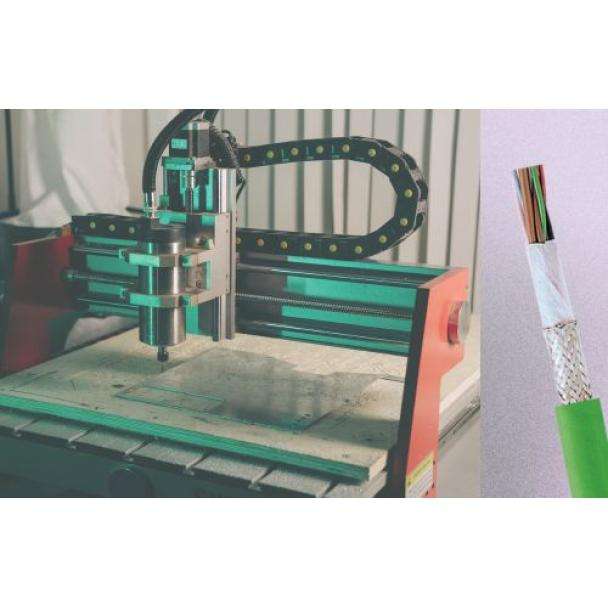
You need one whenever the cable moves with the machine. Examples include CNC machines, robotics, lathes, cutting and milling machines, and overhead cranes.
In these moving-axis applications, the cable runs through a drag chain (also called an energy chain, cable carrier or power chain). It bends back and forth continuously for years. Standard instrumentation cable fatigues under that movement: conductors crack and the shield breaks down, causing intermittent faults that are hard to trace. A drag chain rated cable is built with fine-stranded conductors and a flexible sheath to survive continuous flexing.
FLEX-08CORE-TP: Our Drag Chain Rated Encoder Cable
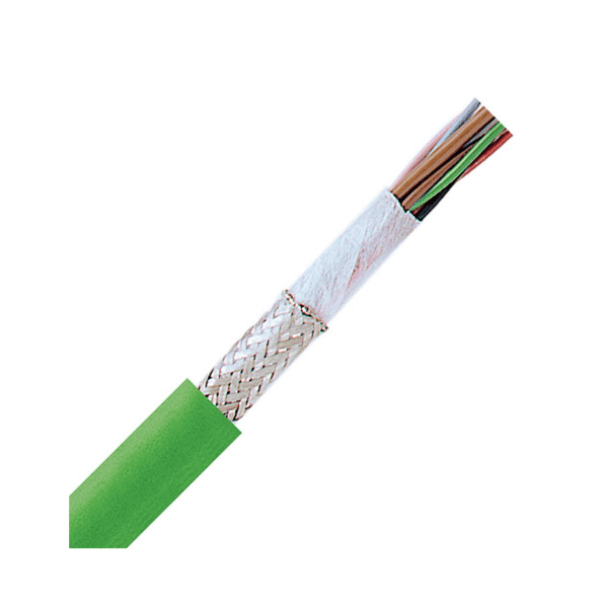
The FLEX-08CORE-TP is a durable, flexible encoder cable made for demanding industrial conditions. Its eight cores are arranged as four twisted pairs. That's enough for A, B and Z with their complements, plus supply and 0 V. A thermoplastic polyurethane (TPU) outer sheath resists abrasion, most chemicals and harsh weather.
| Specification | FLEX-08CORE-TP |
| Construction | Multi-core twisted pair, 4 × 2 × 0.18 mm² |
| Conductor size | 0.18 mm² |
| Shield | Tinned copper wire braid, 85% coverage |
| Outer sheath | Thermoplastic polyurethane (TPU) |
| Outer diameter | 6.4mm |
| Drag chain related | Yes |
| Minimum bend radius (moving) | up from 7.5 x outer diameter |
| Temperature range | Flexing: -40°C to +90°C (UL/CSA: +80°C) Fixed installation: -50°C to +90°C (UL/CSA: +80°C) |
FLEX-08CORE-TP is held in stock for short lead times. Orders received by 1:00 pm AEST/AEDT are dispatched the same business day.
Installation Tips for Reliable Encoder Signals
- Terminate the shield as the drive or encoder manufacturer specifies, usually with a 360° clamp at the control end.
- Run encoder cables apart from motor power cables. Where they must cross, cross at 90°.
- In a drag chain, lay the cable flat without twisting it. Use dividers so it can't rub against other cables.
- Respect the minimum bend radius and leave the cable free to move inside the chain. Clamp it only at the fixed and moving ends.
- Keep runs as short as practical, and check the encoder's maximum cable length for its output type and frequency.
Encoder Cable FAQs
Can I use standard instrumentation cable for an encoder?
On a fixed installation, a shielded twisted pair instrumentation cable may work. On anything that moves, use a drag chain rated cable, or it will fail early.
What's the difference between a drag chain cable and a flexible cable?
A flexible cable bends easily during installation. A drag chain cable is designed and tested to keep bending continuously for millions of cycles.
How many cores does an encoder cable need?
A line-driver incremental encoder with A, B and Z channels plus power needs eight cores, which is why FLEX-08CORE-TP uses four twisted pairs.
Is FLEX-08CORE-TP suitable for outdoor use?
Yes. Its TPU sheath resists harsh weather, abrasion and most chemicals.
Need an Encoder Cable? Talk to PCA
If your project needs a drag chain rated cable for encoders, contact our team or call 1300 236 467. We can help match the cable to your encoder, drive and chain, and we offer technical support after the sale.