Rotary Encoder Couplings: Selection Guide for Solid & Hollow Shafts
Rotary encoders are precision instruments that operate in a harsh, dynamic mechanical environment. No matter the encoder type or application, the measurement depends on repeated movement, and it all comes down to tight mechanical tolerances.
A very common failure mode in practice is premature bearing failure, almost invariably due to rigid mounting.
In the encoder installation environment, nothing is ever really static. The motor shaft flexes under load, the end bells expand thermally, and the drive couplings introduce runout. When you bolt the encoder down rigidly across both the rotating and the stationary elements, the internal bearings are subjected to continuous dynamic bending moments, radial side loads and axial thrust. This, in turn, leads to rapid bearing race pitting, seal degradation, and signal distortion.
To protect your encoders and maintain positional accuracy, you absolutely must decouple them from the drive system. The method depends on whether the installation uses a solid-shaft or hollow-shaft encoder.
Short on Time? Send any questions through our contact page here, or call us directly on 1300 236 467
Preventing Encoder Bearing Failure: Splitting Mechanical Constraints
Golden rules apply to both hollow-shaft and solid-shaft encoders; split the mechanical constraints.
For solid shaft encoders, the encoder housing is rigidly bolted or clamped to the machine frame via a face mount or flange. The input shaft is then connected to the prime mover via a flexible shaft coupling, which isolates the internal bearings from any angular, radial, or axial misalignment.
For hollow shaft encoders, the rotor clamps onto the rotating machine shaft via a collar or set screw. The encoder housing (stator) must be held in place so it doesn't rotate; a flexible stator coupling or tether achieves this by allowing the stator to flex and absorb shaft runout and thermal float.
Types of Solid Shaft Encoder Couplings
A flexible shaft coupling must transmit rotational angle with high fidelity while remaining flexible enough to cope with minor shaft misalignments. Different coupling geometries achieve this balance in different ways.
Bellows Couplings for High-Precision Servo Systems
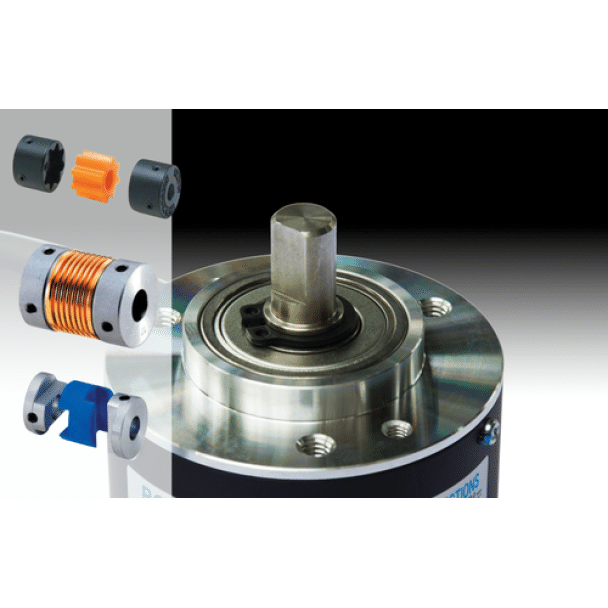
Bellows Couplings are typically constructed from thin-walled hydroformed or electrodeposited stainless steel corrugated bellows, joined to machined aluminium or steel clamping hubs.
Bellows couplings have excellent torsional stiffness and true zero backlash.
These couplings are used in applications with sharp acceleration and deceleration curves, such as high-bandwidth closed-loop servo systems, high-precision CNC machine tools, grinding spindles, and rotary index tables. The bellows coupling is beneficial in multi-turn absolute position installations, where positional error is caused by phase lag (or angular wind-up).
Standard Helical (Beam) Couplings
The helical (or beam) coupling is machined from a solid bar of aircraft-grade aluminium or stainless steel. It has a continuous helical/spiral cut along the body.
Helical couplings have moderate torsional stiffness, zero backlash and are essentially continuous with no mechanical joints.
These couplings are generally found in general automation, packaging machinery, conveyor feedback systems and stepper/light servo drives. They're used in situations where you have a compact machine envelope, and you need an economical one-piece connection with no wearing parts.
Image
Oldham Couplings for VFD Applications
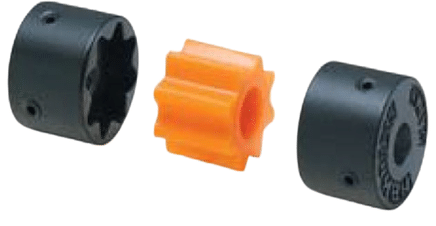
Oldham couplings are a three-piece assembly comprising two slotted metal drive hubs keyed together with a floating centre-disc (usually polyacetal/Delrin or PEEK).
Oldham couplings have high torsional stiffness with zero backlash when new and provide excellent compensation for parallel misalignment via sliding on the disc tenons. The centre disc also provides additional electrical insulation between the motor and the encoder because of its non-conductive polymer composition.
These encoder couplings are frequently used in VFD-powered applications where common-mode current and shaft voltage can cause EDM bearing pitting. This includes conveyors, pumps, and general manufacturing where you won't have perfect coaxial alignment.
Image
Curved Jaw (Spider) Couplings for Heavy Shock Loads
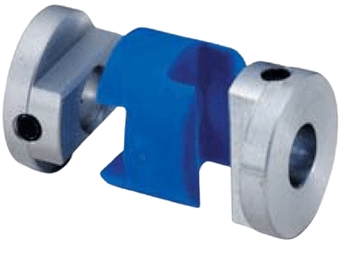
Curved jaw couplings have two interlocking machined cast or aluminium hubs with curved jaw fingers that close around an elastomeric polyurethane spider insert.
These coupling variations generally provide moderate torsional stiffness, good vibration damping, and good mechanical shock absorption. Because they can absorb mechanical shock, they’re often considered fail-safe: if the polyurethane spider fails, the metal jaws mesh mechanically to prevent a complete loss of drive.
In application, they do allow a small amount of torsional windup under peak torque and are therefore better suited to velocity feedback than sub-millimetre dynamic positioning.
The curved jaw, or spider coupling, can be used in heavy industrial applications (crushers, mixers, extruders, stamping presses, material handling lines, etc.) and can also include pulsating torque or shock loads which would fatigue a metal beam coupling.
Double Loop Couplings for High Misalignment
The double loop coupling is a high-strength, flexible thermoplastic polyurethane coupling which is looped and swaged onto plated steel or brass hubs. It has low torsional stiffness but very high multi-directional flexibility. It's ideal for high-misalignment drives, secondary machinery lines, and equipment with significant frame flex or thermal movement.
This type of coupling is ideal for applications involving RPM counting, speed control and velocity monitoring where a degree of angular compliance will not adversely affect control performance.
Stator Couplings for Hollow Shaft Encoders
Hollow shaft encoders eliminate external shaft couplings by sliding directly over the machine shaft. The encoder housing must remain stationary while moving freely axially and radially with the machine shaft's runout.
Stator couplings, or spring tethers, offer high resistance to twisting to keep counts accurate, while still allowing movement in both axial and radial directions.
PCA offers two types of stator couplings: the Posital 1B63 and the 1Y80-150.
POSITAL 1B63 Stator Coupling (10043015)
This stator coupling is a spring-steel flat flex tether designed for 58mm blind hollow shaft encoders and provides a fixed 63mm bolt circle diameter.
The Posital 1B63 is great for compact setups like tool spindles, robotics, and pick-and-place actuators with limited space. These mounts connect directly to modern AC servo motors and brushless DC drives with standard 63 mm pitch-circle holes on the rear end-bell.
The 1B63 stator coupling keeps high torsional rigidity for repeatable positioning during fast reverse cycles, and it allows axial flex to handle thermal expansion of the motor shaft during long runs.
POSITAL 1Y80-150 Adjustable Stator Coupling (10043021)
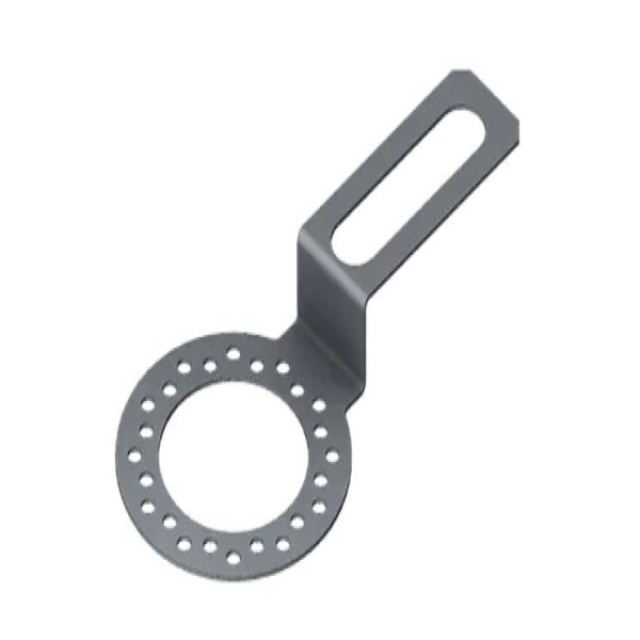
The Posital 1Y80-150 is a slotted, multi-arm stainless steel tether for 58mm blind hollow shaft encoders. It has an adjustable bolt radius from 80mm to 150mm.
It’s made for tough environments where big frame sizes cause thermal expansion and vibration. It’s ideal for adding encoders to large IEC/NEMA motors, industrial gearboxes, and older machines without a small bolt circle.
The 1Y80-150 offers a wider reach and more flexibility so that it can absorb more runout, vibration, and thermal expansion.
Image
Need Help? Call Today!
If you need help choosing the right coupling for your hollow or shaft encoders, the PCA team is ready to assist you! Send any questions through our contact page here, or call us directly on 1300 236 467
Image