How to Track Linear Speed and Displacement Using Rotary Encoders and Measuring Wheels
Measuring linear displacement or speed directly from a moving surface requires a sensor that physically contacts the surface.
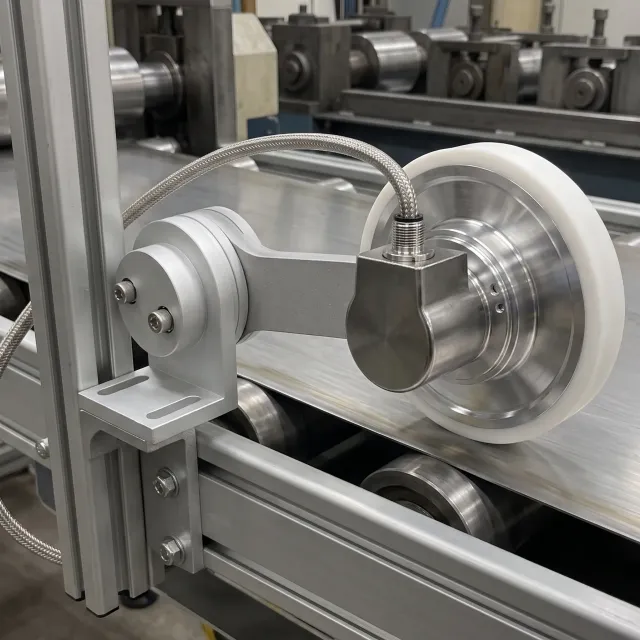
Typically, a rotary encoder measures the shaft rotation of the conveyor's motor or roller; however, pairing a solid-shaft encoder with an encoder wheel and spring-loaded pivot arm enables direct, high-accuracy surface tracking.
This combination of encoder, wheel, and spring-loaded pivot arm can support accurate monitoring of displacement and speed across conveyor systems, web handling, textile, printing, and continuous extrusion lines, as well as automated cut-to-length batch sorting machinery.
Image
Short on Time? Send any questions through our contact page here, or call us directly on 1300 236 467
How To Convert Rotary Signals to Linear Distance?
With the three-piece ensemble, installing engineers need to scale encoder pulses into meaningful engineering measurements, such as imperial or metric units. To do this, factor in the wheel circumference and the encoder's pulses per revolution (PPR).
Distance per Pulse = Wheel Circumference (mm) / Encoder PPR
Linear Speed (m/min) = (RPM × Wheel Circumference (mm)) / 1000
For example, pairing a 500 mm circumference wheel with a 1024 PPR encoder yields:
500 ÷ 1024 = 0.488 mm of travel per pulse.
Eliminating Slip with Matching Wheel Profiles
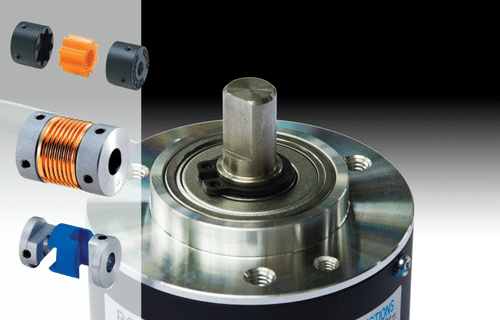
Encoder measuring wheels attach directly to solid-shaft encoders to measure linear travel. These measuring wheels are available in a range of standard circumferences (e.g., 200 mm, 500 mm), and their accuracy depends on traction. To prevent slip on different target materials, the wheels are constructed with three different contact surfaces:
- Knurled aluminium: For metal, timber or heavy industrial webs.
- Textured plastic: For structured materials and conveyor surfaces where grip is required without the surface being marked.
- Flat plastic: For smooth, sensitive or delicate materials.
PCA offers standard bores in 6mm, 10mm, and 12mm.
Image

Maintaining Continuous Contact with Spring-Loaded Arms
Intended application material thickness can vary, and surface vibration and conveyor-belt bounce can lift a wheel off the product, causing missed pulses. To address this, the POSITAL 10072050 Spring Loaded Pivot Arm provides constant mechanical downforce.
These spring-loaded arms are lightweight (380g) aluminium units, with an operating temperature range of -30°C to +60°C. It is designed to mount to a standard 58 mm clamping-flange solid-shaft encoder and will take wheels from 300mm to 500mm in circumference. The unit has a modular bracket, allowing it to be mounted in almost any orientation to suit the constraints of a particular plant layout.
Image

Need a Hand? Call Today!
If your installation could require a combination of an encoder wheel and a spring-loaded pivot arm, the PCA team is here to help! Send any questions through our contact page here, or call us directly on 1300 236 467
Image