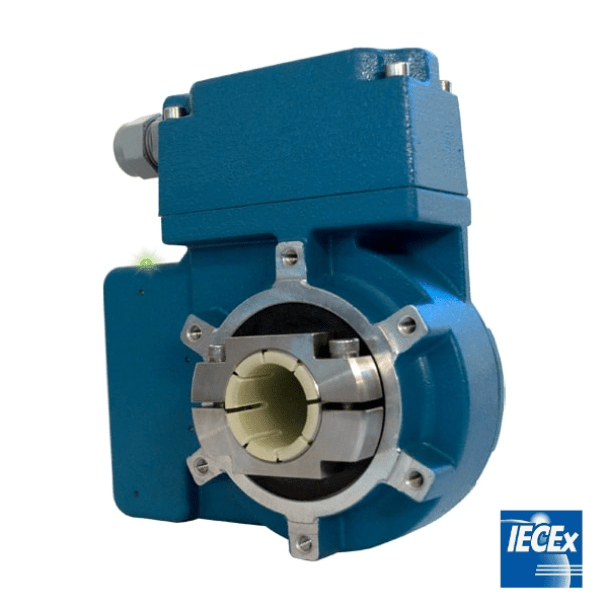
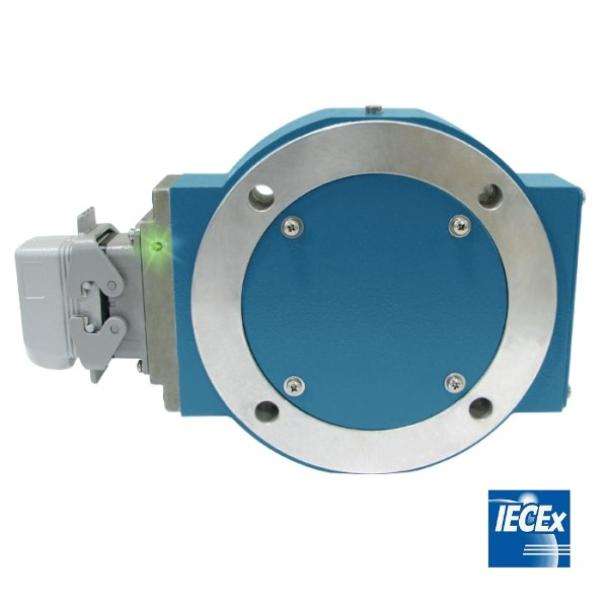
Specifying IECEx Encoders for Hazardous Areas: Zones 1/21 vs. Zones 2/22
Selecting a rotary encoder for an Australian mine, grain terminal, or petrochemical plant is more than just matching up shaft size and pulses. If it's going to be used in an explosive atmosphere under the IECEx scheme and AS/NZS 60079 standards, it must be designed to prevent ignition via electrical spark, hot surface, or electrostatic discharge.
Understanding the differences between Zones 1 & 21 and Zones 2 & 22 is the key to specifying compliant hardware without over-engineering your budget.
Short on Time? Send any questions through our contact page here, or call us directly on 1300 236 467
Understanding the Two Zone Groups
Hazardous zones are classified by the type of hazard—flammable gas/vapour (Zones 1 and 2) or combustible dust (Zones 21 and 22)—and how frequently that hazard is present:
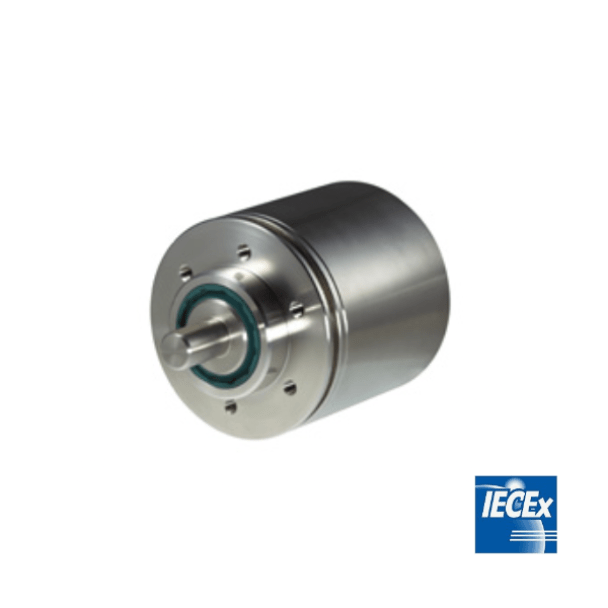
- Zones 1 & 21 (Normal Operation Risk): Explosive gas or combustible dust clouds are likely to occur during normal operations. Encoders here typically use flameproof (Ex db) and dust-ignition-proof (Ex tb) enclosures. Rather than merely preventing sparks, these heavy-walled housings act as pressure vessels. Precision-machined metal flamepaths along the shaft and joints cool escaping gases if an internal explosion occurs, preventing ignition of the surrounding atmosphere.
- Zones 2 & 22 (Abnormal/Fault Risk): Explosive atmospheres are not expected during normal operation and only occur briefly during an abnormal fault. Encoders here rely on non-sparking (Ex nA/Ex ec) electronics and dust-protected (Ex tc) enclosures, allowing for lighter, more compact housings.
Physical Composition & Material Standards
Regulatory compliance dictates strict material rules for both zone groups:
- Metallic housings and shafts: Zone 1/21 encoders generally use thick-walled 316L stainless steel, cast iron, or low-magnesium aluminium. In the case of underground coal mining (Group I), where the use of light metals is strictly prohibited to prevent thermite sparking, stainless steel is the only viable option. Zone 2/22 units are more likely to be anodised aluminium, coated steel or 303/316 stainless steel.
- Dynamic shaft seals: the rotating shaft is the natural path for leakage. Zone 21 requires IP6X (totally dust-tight) and Zone 22 requires IP54 or IP6X (again depending on whether the dust is conductive). The high-grade FKM (Viton) or PTFE shaft seals must pass thermal endurance ageing before ingress testing.
- Anti-static surfaces: the external paint and non-metallic parts must either have a coating thickness limited to less than 0.2mm (for Group IIC gases) or have a surface resistance of less than $10^9\ \Omega$ to prevent the generation of electrostatic brush discharges.
Permitted Encoder Technologies
IECEx certification focuses on ignition protection rather than restricting the sensing physics, so both incremental and single-turn/multi-turn absolute rotary encoders are widely available.
- Magnetic encoders are the preferred choice in tough environments because they don't have the fragile glass discs that other encoder types do. Multi-turn energy-harvesting designs also eliminate the need for a backup battery inside hazardous areas.
- Optical encoders: Permitted when contained within a certified flameproof or non-sparking housing, for extremely high-resolution motion control.
Cabling & Communication Protocols
Hazardous area encoders support modern industrial networks as well as traditional outputs (4-20mA analog, HTL/TTL incremental, SSI, CANopen, Modbus, PROFIBUS and PROFINET).
When cabling these devices, installation compliance under AS/NZS 60079.14 is critical:
Direct vs. Indirect Entry
- Flameproof (Ex db) encoders require certified Ex d barrier glands (compound-filled) or factory-potted cables to maintain pressure containment. Zone 2/22 models use certified Ex e/Ex t glands that maintain IP ratings and cable pull-out resistance.
Shielding & Earthing
- Industrial Ethernet and fieldbus cables require continuous metallic shielding and proper equipotential bonding at the encoder housing to prevent stray currents and electromagnetic interference.
By matching the zone classification, housing construction and certified cable entry method to your site's hazardous area dossier, you can be sure of safe and reliable motion feedback in the most demanding of industrial applications.
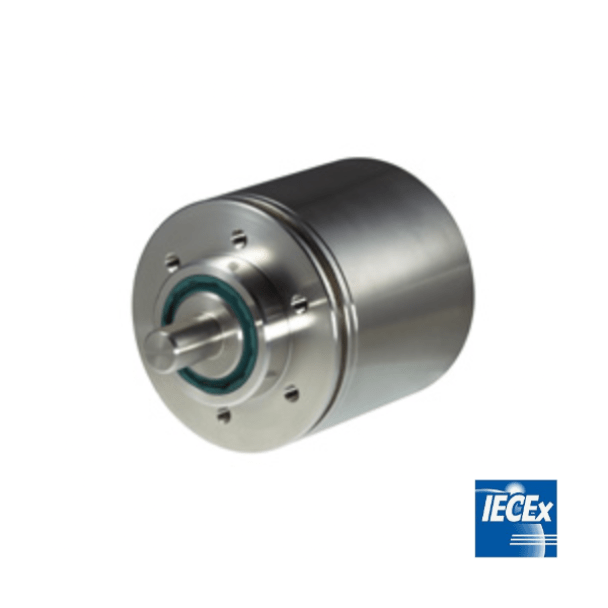
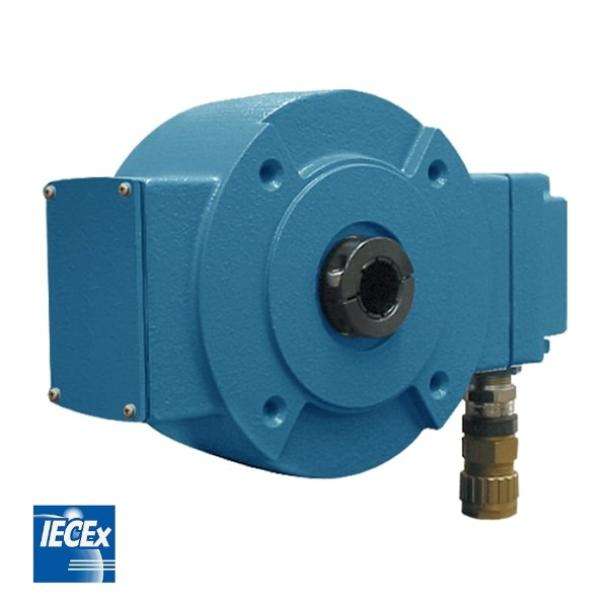
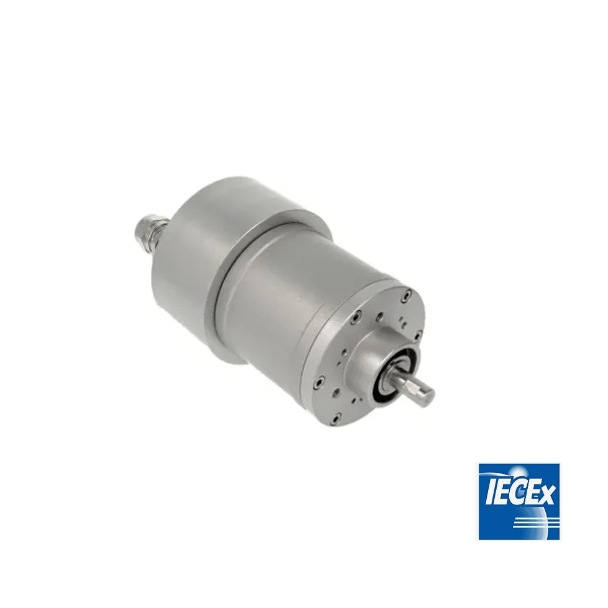
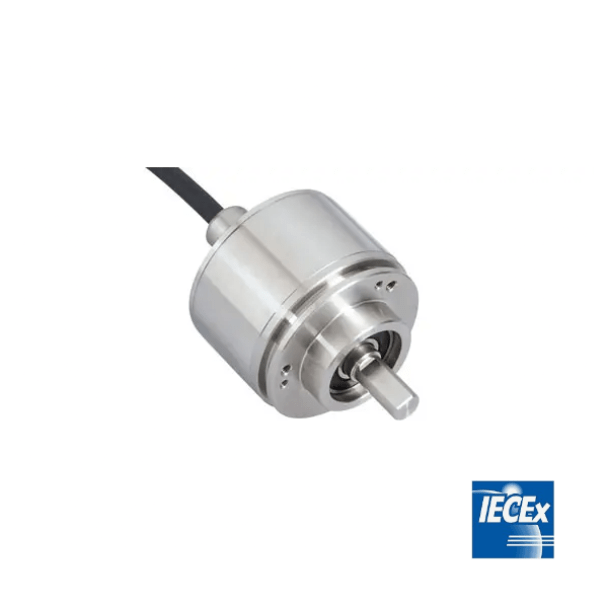
PCA IECEX Encoder Range
| Product Model / Series | Manufacturer | IECEx Hazardous Zone Suitability | Protection Technique | Technology & Output | Enclosure & Materials |
| W+S IX700 | W+S Meßsysteme | Zones 1, 21, 2, 22 (& Mining Group I) | Flameproof (Ex db IIC) & Dust-ignition (Ex tb IIIC) | Optical Incremental (HTL / TTL Push-Pull) | Heavy-duty 316L Stainless Steel, IP66/IP67 |
| W+S AX700 | W+S Meßsysteme | Zones 1, 21, 2, 22 (& Mining Group I) | Flameproof (Ex db IIC) & Dust-ignition (Ex tb IIIC) | Optical Absolute Singleturn & Multiturn (SSI, CANopen, Profibus) | Heavy-duty 316L Stainless Steel, IP66/IP67 |
| Avtron M6C | Avtron | Zone 1 (Gas) | Flameproof / Increased Safety (Ex db eb IIB T4 Gb); no barrier needed | Heavy-duty Magnetic Incremental (1" to 1-1/8" hollow shaft) | Cast aluminium with polyurethane enamel coating, IP66 |
| Posital UCE Series (e.g. UCE-IPT00) | Posital Fraba | Zones 1 & 21 | Flameproof enclosure (Ex db / Ex tb) | Magnetic Incremental (Configurable PPR via UBIFAST) | Heavy-duty aluminium or stainless steel, IP66/IP67 |
| Avtron XR45 | Avtron | Zones 1 & 21 (with XRB3 barrier); Zones 2 & 22 (direct installation) | Intrinsically Safe (Ex ia / Ex ib) via barrier; Non-sparking (Ex ec / Ex tc) direct | Magnetic Hollow Shaft (16–30 mm) | Rugged cast housing, IP65 enclosure / IP67 encapsulated electronics |
| Avtron XR850 | Avtron | Zones 1 & 21 (with XRB3 barrier); Zones 2 & 22 (direct installation) | Intrinsically Safe (Ex ia / Ex ib) via barrier; Non-sparking (Ex ec / Ex tc) direct | Bearingless Modular Magnetic (fits up to 4.5" / 115 mm shafts) | Cast modular sensor housing, IP54 |
| Posital OCF Series (e.g. OCF-S101G) | Posital Fraba | Zones 2 & 22 | Non-sparking & Dust protection (Ex ec / Ex tc) | Optical Absolute Singleturn & Multiturn (SSI Gray code) | 303 / 316 Stainless Steel or coated steel, IP66/IP67 |
| Posital UCF Series (e.g. UCF-IPH00) | Posital Fraba | Zones 2 & 22 | Non-sparking & Dust protection (Ex ec / Ex tc) | Magnetic Incremental (HTL Push-Pull, hollow/solid shaft) | Rugged anodised aluminium, IP65/IP67 |
Need Help? Call Today!
Are you spec'ing out for a project in a hazardous area and need some help finding the right IECEx-rated encoder? The PCA team is here to help! Send any questions through our contact page here, or call us directly on 1300 236 467
Image